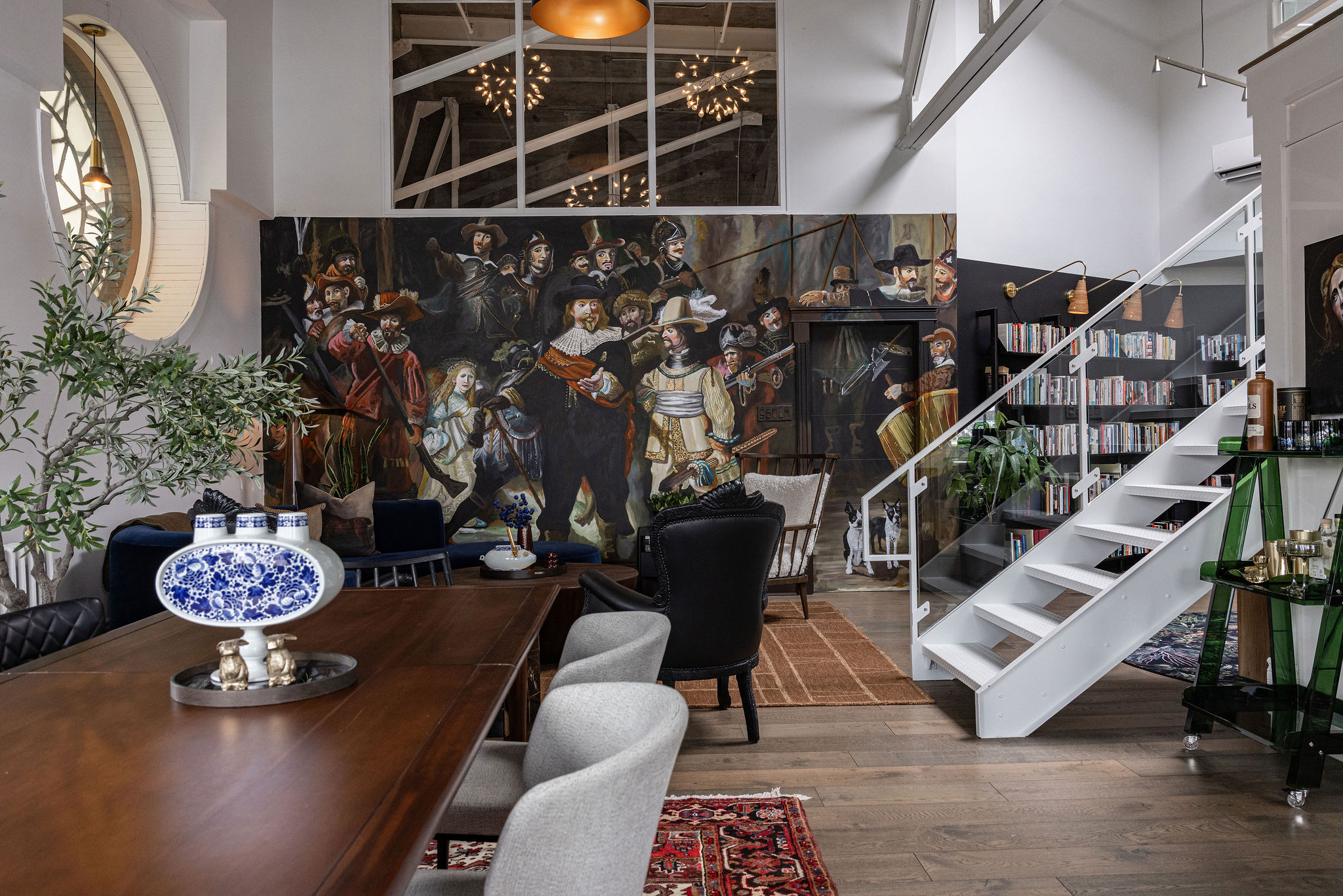
Going Dutch: Robert Moore takes on ‘The Night Watch’ Mural
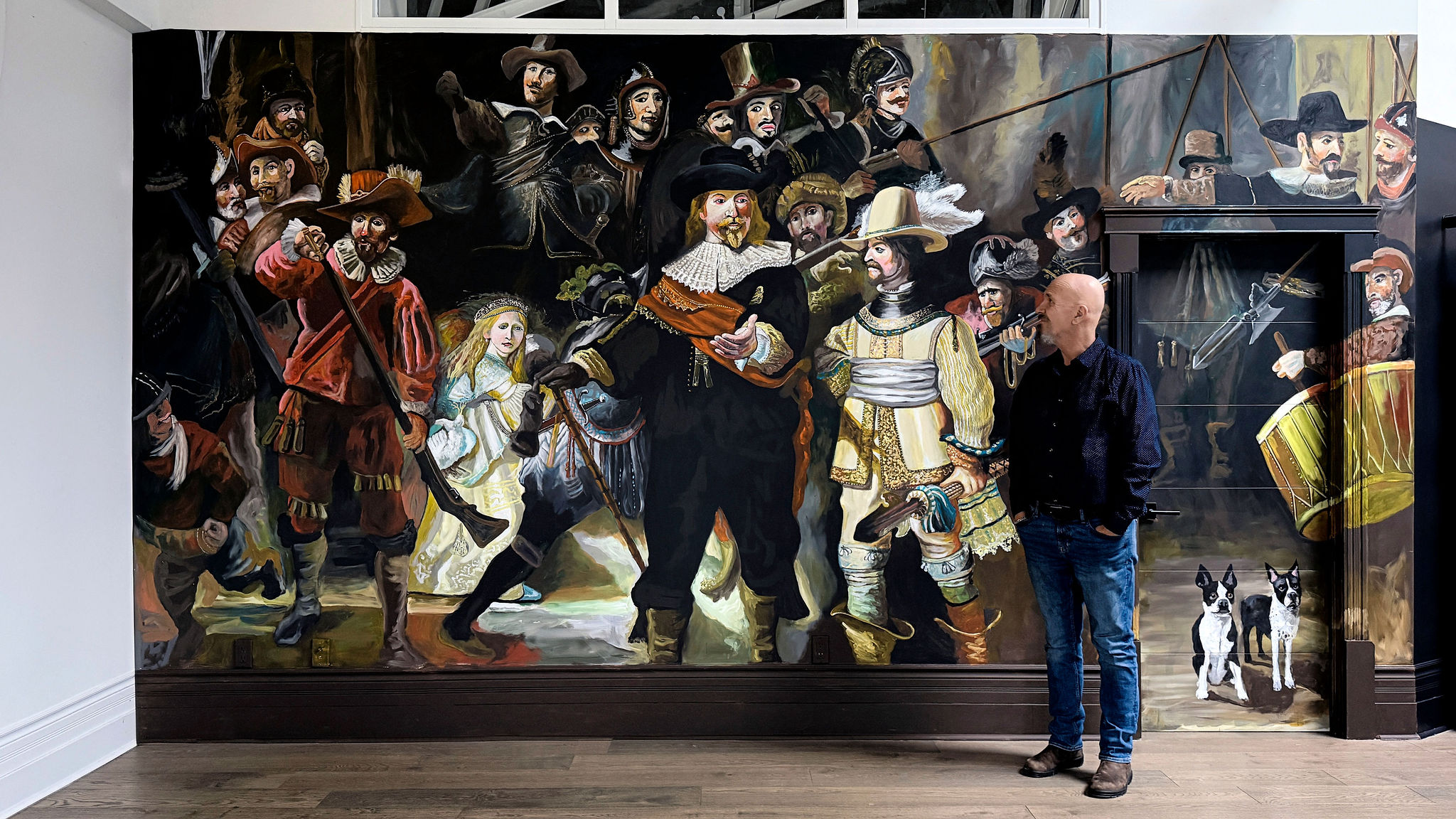
Robert Moore stands in front of his completed 17' x 8'5" mural—his interpretation of The Night Watch—in his Uptown Saint John loft.
Kate Wallace interviews Robert Moore:
When Robert Moore first saw Rembrandt’s The Night Watch at the Rijksmuseum in Amsterdam in 2016, he had museum brain, overwhelmed by the blur of Golden Age masterpieces. If he’s honest, his initial encounter with the massive, almost 400-year-old oil didn’t move him much.
His main impression? “My god, that's a big painting! And boy, it's dark.”
In the years since, on several return trips to the Netherlands’ capital, the Saint John painter’s appreciation for the 12' x 14' (approx.) work has grown alongside his studio practice, which has been increasingly influenced by the Dutch master, especially his approach to portraiture.
On his most recent visit, in September, when his wife, Judith Mackin, suggested he reproduce the 1642 mural in their uptown Saint John penthouse in the old Post Office Building, he agreed. The mural is a gift to his Dutch-obsessed spouse as much as a creative challenge, the largest work by far he’s attempted, and his first mural.
In early January, he began by covering their living room wall with a chocolate-brown background and a grid of six-inch squares. Then he got down to work on the painting proper, starting with the hardest part: a golden sleeve in the foreground. A week later, he was done.
Robert talked to Kate Wallace about the project. The conversation has been condensed for clarity and length. Photography by Kelly Lawson
Editor’s Note:
The mural is only part of the story. On Sunday we will share how Judith designed the loft around Robert’s Night Watch mural and how years of travelling to Amsterdam shaped the space. Read the follow-up story: How Amsterdam Inspired Our Saint John Loft: Dutch Mural & Interior Design Details.
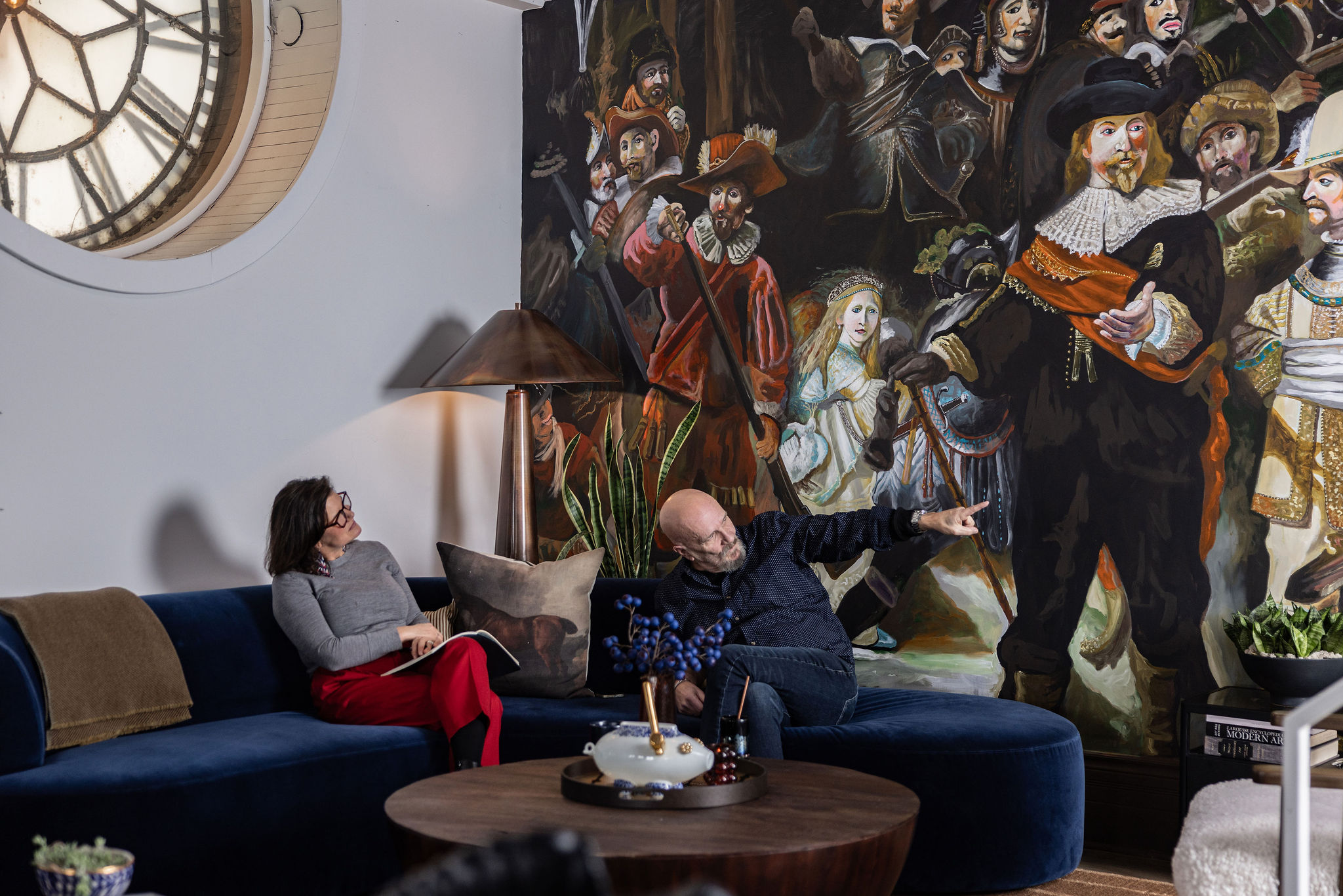
Q & A: Painting the Night Watch Mural in Saint John
This is a famously large, complex painting. Were you daunted?
No, because I'm so used to failing. There's that old saw from Beckett, “Try again. Fail again. Fail better.” Every canvas that goes out of my studio has eight paintings underneath it, all failures. And so, when I started this, what's the worst that could happen? I’d have failed, painted the wall white again, and apologized.
How did you approach it?
You just end up doing a series of small paintings. You're always painting six-inch squares.
What did you learn about Rembrandt in reproducing his most famous painting?
He’s very attentive to the psychology of how we look, how we see, and maybe how we remember. He’s clearly sensitive to how the visual reconstructs reality. He's not so much interested in capturing the surface of the world; he's interested in capturing how we look. That really interested me, and my approach to portraits.
What’s special about how he paints people? There are 22 distinct subjects in The Night Watch.
When you reproduce it, you realize how simple some of these faces are. They're just a plane, a plane, a plane, and a couple of strokes around the helmet or something like that.
The two figures in the foreground are very clearly delineated and very detailed. But as you get to the margins, they're just smudges. Part of it was a commercial consideration: If you paid more, you got a better position. But that's also how we would look at a crowd: “Who's that guy in the gold suit? Wow, he's got money!! And the rest of the people are just kind of shuffling in the gloom.
Why do you think Rembrandt was attuned to his subjects in this way?
(The philosopher) Descartes was living in the city at the same time, and the advent of the self was happening in the West. I think it was just the zeitgeist. They were breathing the same air, walking the same canals.
Rembrandt, more than any of his contemporaries, is interested in the psychology of the self as an identity in time. He's exploring the phenomenon of what it is to breathe, to have a pulse in the world.
What is actually happening in this big, busy painting depicting Captain Frans Banninck Cocq’s civic guard company?
Apparently, these guys never saw action, but they're all very proud of their weapons. They’re gentleman soldiers. They’re more interested in parading. They liked getting dressed up for an evening march around the city. They just look like Dad’s Army.
He’s kind of making fun of them. Because first of all, there’s this gun going off, and a rusty pike. He's letting us know what's really happening here.
He's being serious because he's got to get paid by presenting their dignity, pride, their inflated sense of self. But he's also puncturing that.
That sly wit is also a trademark of your paintings.
Yes. If it doesn’t have irony, I’m not interested. Dignity is of no interest. Or piety.
What were some of the challenges you faced in this project?
When it was all done, and I stood back from it, it was wrong. Not awful, but not right; out of sync.
Judith, to her credit, said the blues and greens were wrong. Something about how they were functioning in this room was throwing off the balance. That was a discovery. My interest was in managing the values.
Including that colour correction, you were done in a week. That’s fast!
I paint quickly. I don’t like details. Once I know how to do something, I want to move on.
But it reads as a lot of detail.
The sheer mass of detail is enormous, true. But something that might have taken Rembrandt days took me 20 minutes. He was inventing; I was copying. My only job was to make the copy convincing. All the heavy lifting had been done. Plus, the original audience would have been much more discriminating. Those were their faces, after all.
Your paintings often bring contemporary elements into classical scenes. Did you do that in this work?
Bad Bunny got in there briefly because I finished over Super Bowl weekend. And the dogs, of course.
Note: Bad Bunny is the tophatted soldier above the two central figures; Scout and Macey, Robert and Judith’s dearly departed Boston terriers, stand in for Rembrandt’s sole canine.
Is this your first mural?
My sister reminded me that when I was a teenager, I used to do our Christmas window with poster paints. Everyone looked forward to it. It’d be the most hackneyed, cliched Santa scene.
But on a wall? This is the first time I’ve done that. Maybe the last.
Why?
Well, it’s a lot of work!
What’s it like living with it?
Great! I really like it when I go upstairs in the morning, and it’s dark, and this golden light is bathing it. This is good! It works.
What do you think Rembrandt would think of it?
Thief! (laughs)
Kate Wallace is a national award-winning journalist, writer and storyteller whose work spans print media, brand storytelling, and filmmaking. A former arts reporter for the New Brunswick Telegraph-Journal and executive director of ArtsLink NB, she founded Kate Wallace & Co., a one-woman copywriting agency. Kate lives in Rothesay with her husband, son, cat Betty, and lots of pottery. She is at work on a memoir about ADHD parenting and personhood.